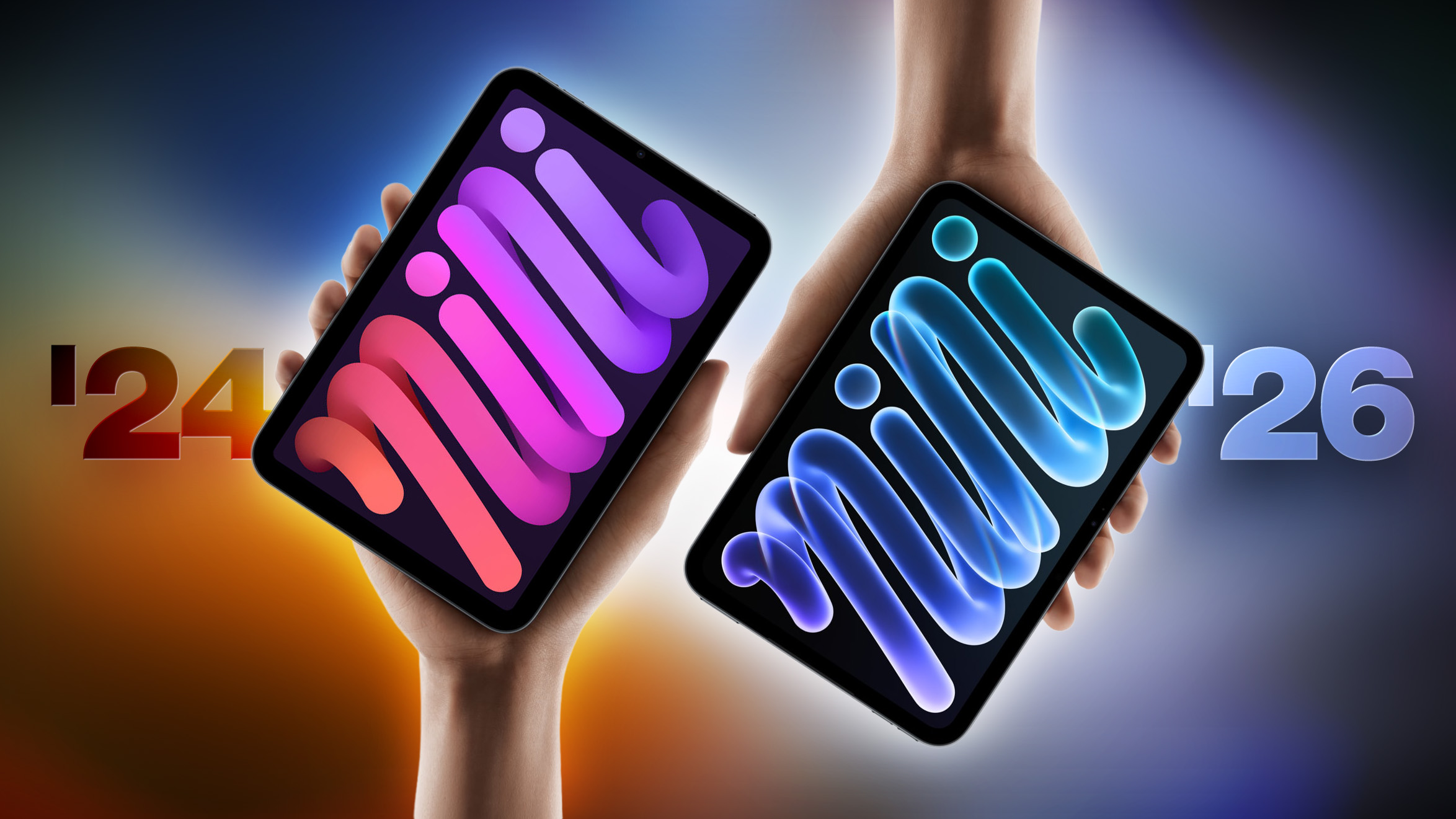
iPad Mini 2024 vs. 2026 Buyer’s Guide: Should You Upgrade?
Apple today announced the eighth-generation iPad mini, introducing a larger OLED display, a thinner and lighter design, the A20 Pro chip, and water and dust resistance, but how much does it differ from the previous model?
The new iPad mini starts at $699 for the 128GB Wi-Fi model and $849 with cellular connectivity. With the prior generation now discontinued, buyers also face a choice between paying for the new features and finding a cheaper A17 Pro model. Both offer the same storage capacities, advertised battery life, Touch ID authentication, and USB-C transfer speeds, so the new model does not improve every aspect of the experience.
Here are the key differences between the iPad mini with the A17 Pro chip from 2024 and the iPad mini with the A20 Pro chip from 2026:
iPad mini (seventh generation, 2024)
iPad mini (eighth generation, 2026)
8.3-inch display
8.5-inch display
Liquid Retina display with LED backlighting and IPS technology
Super Retina XDR OLED display with 1-nit minimum brightness and 2,000,000:1 contrast ratio
2266-by-1488 resolution
2316-by-1512 resolution
Wider display borders
24% thinner display borders
500 nits maximum brightness
600 nits maximum SDR and full-screen HDR brightness; 1,200 nits peak HDR brightness
Optional nano-texture display glass on 256GB and 512GB models for an additional $100, supplied with a polishing cloth
Extended external display mode with iPadOS 27.2
IP67 water and dust resistance, rated for a maximum depth of 1 meter for up to 30 minutes
A17 Pro chip
A20 Pro chip, with CPU and Neural Engine configurations varying by storage capacity
Portrait front camera
Landscape front camera
Center Stage front camera with ƒ/2.4 aperture
Center Stage front camera with ƒ/2.0 aperture
True Tone rear flash
Adaptive True Tone rear flash
Landscape stereo speakers with external speaker holes
Acoustic Display with display-coupled woofers and concealed tweeters, without external speaker holes
Third-party wireless module
Apple N1 wireless networking chip
Wi-Fi 6E connectivity
Wi-Fi 7 connectivity
Bluetooth 5.3 connectivity
Bluetooth 6 connectivity
Thread networking technology
Qualcomm Snapdragon X70 5G modem (Cellular models only)
Apple C2 5G modem; up to 50% faster cellular data speeds according to Apple (Cellular models only)
U.S. cellular model (A2995) supports 5G band n76
U.S. cellular model (A3596) supports LTE band 106
UMTS/HSPA/HSPA+/DC-HSDPA cellular support
UMTS/HSPA/HSPA+ cellular support
19.3Wh battery
18.9Wh battery
Fast charging up to 50% in around 30 minutes with a 35W or higher USB-C power adapter
Available in Space Gray, Starlight, Purple, and Blue
Available in Midnight and Starlight
Previous polyurethane Smart Folio design
Redesigned two-panel TechWoven Smart Folio with adjustable viewing angles, available separately in Navy Blue and Taupe for $79
More than 25% recycled content overall
35% recycled content overall
Originally started at $499 (Wi-Fi) or $649 (Wi-Fi + Cellular); Wi-Fi starting price subsequently increased to $599; now discontinued
Starts at $699 (Wi-Fi) or $849 (Wi-Fi + Cellular)
A17 Pro vs. A20 Pro
Unlike the previous model, the new iPad mini’s chip hardware now varies according to storage capacity:
iPad mini (seventh generation, 2024)
iPad mini (eighth generation, 2026)
Chip
Apple A17 Pro
Apple A20 Pro
Manufacturing process
3-nanometer
2-nanometer
CPU
6 cores
128GB and 256GB: 5 cores
512GB: 6 cores
Higher-performance CPU cores
2 performance cores
2 super cores
Efficiency CPU cores
4 cores
128GB and 256GB: 3 cores
512GB: 4 cores
GPU
5 cores
7 cores
GPU Neural Accelerators
Dedicated Neural Accelerators in each GPU core
Neural Engine
16 cores on all storage configurations
128GB and 256GB: 16 cores
512GB: Dual 16-core Neural Engine, totaling 32 cores
Unified memory
8GB
Increased capacity, according to Apple; exact amount not yet known
Unified memory bandwidth
51.2 GB/s
115.2 GB/s
Apple also claims that the new model has the following maximum improvements over the previous model with the A17 Pro chip:
Up to 60% faster multithreaded CPU performance.
Up to 2.7 times faster graphics performance.
Up to 4.5 times faster AI performance.
Dimensions and Weight
iPad mini (seventh generation, 2024)
iPad mini (eighth generation, 2026)
Height
7.69 inches (195.4 mm)
7.69 inches (195.3 mm)
Width
5.3 inches (134.8 mm)
5.22 inches (132.6 mm)
Thickness
0.25 inch (6.3 mm)
0.21 inch (5.4 mm)
Weight (Wi-Fi)
0.65 pound (293 grams)
0.56 pound (255 grams)
Weight (Wi-Fi + Cellular)
0.66 pound (297 grams)
0.58 pound (263 grams)
The new model is approximately 14% thinner, with the Wi-Fi model approximately 13% lighter and the cellular model approximately 11% lighter.
Should You Upgrade?
Most A17 Pro iPad mini owners can comfortably keep their current device. The new model offers the same advertised battery life, storage capacities, Apple Pencil support, and USB-C transfer speeds. If your iPad mini still meets your needs, there is little reason to upgrade for everyday performance alone.
The slightly larger display now with OLED technology may be the strongest reason to consider replacing it, particularly if you frequently use your iPad mini for watching videos or reading. The thinner and lighter design may also make a worthwhile difference if you spend long periods holding it.
For users who regularly encounter distracting reflections or enjoy reading on their device, nano-texture glass could provide a more specific reason to upgrade. It does raise the cost considerably, since it requires at least 256GB of storage as well as the additional $100 display option.
The landscape camera, water resistance, and fast charging are useful additions, but are highly unlikely to justify replacing a A17 Pro model on their own. An upgrade makes more sense when several of these changes address things you find limiting about your current device.
Which Model Should You Buy?
For most new buyers, the A20 Pro model should be the starting point. The OLED display and new design are its main advantages, and both largely matter more to the everyday experience than the chip.
The A17 Pro model may still be worth considering when it offers substantial savings. It retains many of the same capabilities and remains a sensible choice for reading, browsing, taking notes, and watching videos, even if it uses the design of an older device.
For the A20 Pro model, it is important to remember that the 256GB version makes nano-texture glass available, while the 512GB version adds a CPU core and a second Neural Engine. Related Roundup: iPad miniBuyer’s Guide: iPad Mini (Coming Soon)Related Forum: iPadThis article, “iPad Mini 2024 vs. 2026 Buyer’s Guide: Should You Upgrade?” first appeared on MacRumors.comDiscuss this article in our forumsMacRumors: Mac News and Rumors – Front PageRead More